
AFTER COLORISM. THE NEW GDAŃSK SCHOOL
“The Granary Island is a place (extraterrestrial) provoking a special feeling of the space of history, of what is gone and at the same time – what is participating, present as a cultural fertilizer, fermenting deposits. Working on the “Island" I drew from my awareness of multitude of layers under my feet, debris, soil, burnt grain, charred floors etc. (…) I was constantly encountering the lost elements, restored layers which influence the shape of presently created buildings (...). The evoked space, this place – the Grannary Island – is only a model, a shortcut of broader, more general search for another space, another land, a mythical land of artistic fulfillment, the land which is perversely close because it sticks under the feet as the only one which is possible to be fulfilled here and now".
Grzegorz Klaman, Archeologia odwrotna, 1985
After the fall of the Socialist realism doctrine, the capitalist traditions of Sopot School were shaken to the foundations. Piotr Potworowski's short but intense stay in Sopot influenced it. Within four years, this artist, who had a considerable standing, presented a conflict-free way of moving towards modern painting. He himself was a colorist of a great sensitivity to color and light but he used his own method, quickly accepted in the Tricity circles. Soon, apart from Potworowski's adepts, independent artists appeared on the Coast: among others, Władysław Jackiewicz and Kazimierz Ostrowski. The turn of the 1950s and 1960s was also the period of fascination with the matter-painting and Tachisme – commonly regarded as a weapon against Colorism. Once monolithic, with time the Tricity artistic circles became a place of work for numerous artists working outside all currents. Most unusual of them were Kiejstut Bereźnicki and Hugon Lasecki. In the face of a feast of various artistic phenomena that took place over a few decades after the Socialist realism, it was only the 1980s that brought a true revolution. The change which affected at that time the young graduates of the Gdańsk Academy of Fine Arts, changed the conservative image of the Tricity circles. The new Gdańsk School was established in opposition to not only the conservative tradition of the Sopot School, but also to the entire institutional-academic model promoting the primacy of painting. Young artists from the generation which grew up in the period of intense opposition activity of “Solidarity" were against non-political art. They strived to stress the Gdańsk identity in the search of alternative spaces and means of expression which would combine the art forms with literature, theatre, land art, video, new media and performance.
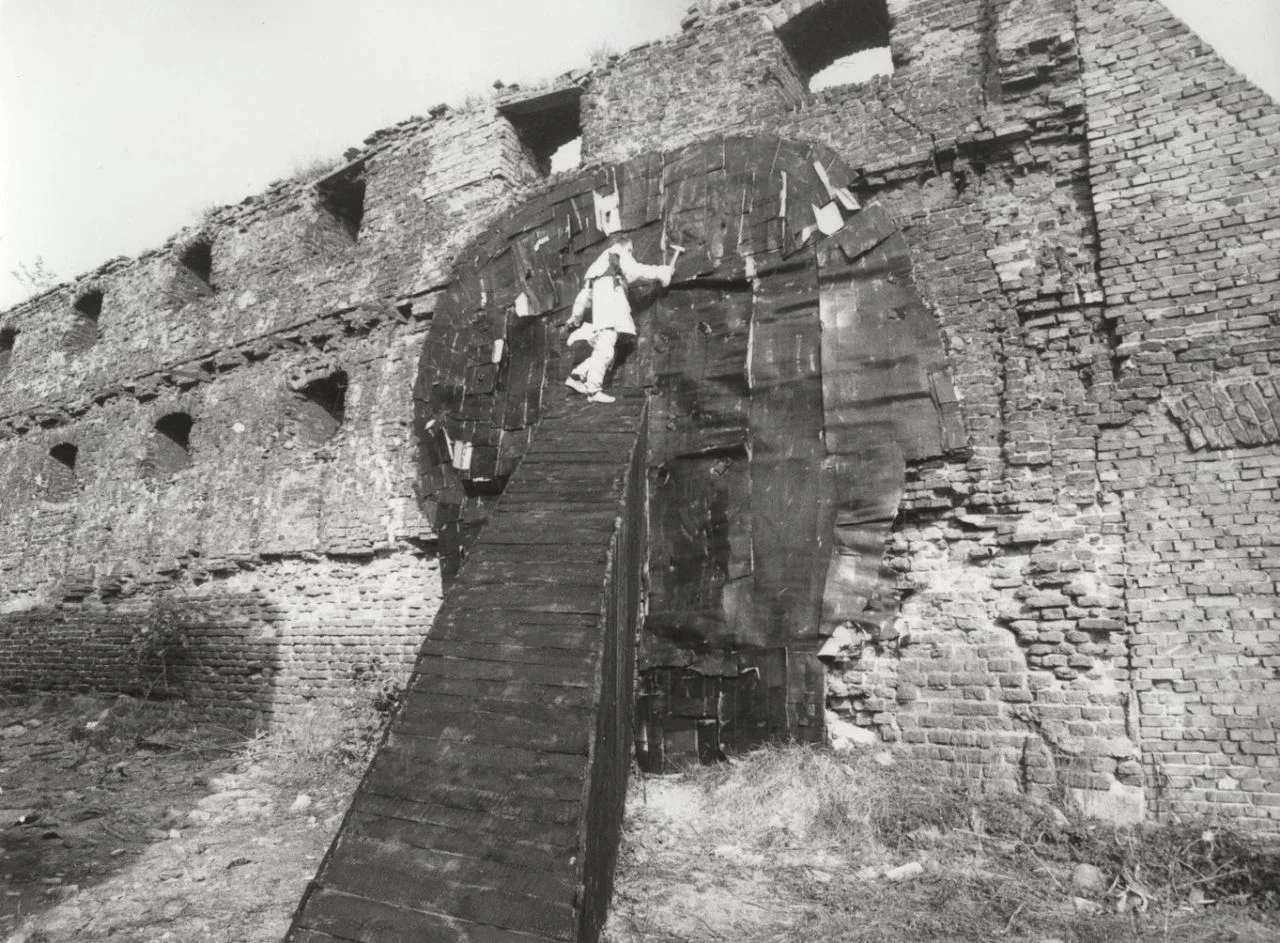
The Granary Island - the space in the center of Gdańsk with ruins of granaries and plants - has become the area of the most intense activity. It was here that Grzegorz Klaman and Kazimierz Kowalczyk, while still students, undertook some actions as part of the activity of Galeria Rotacyjna (Rotary Gallery). Determined young adepts of art did not have many opportunities of presenting their art at that time, although the Coast in 1980s seemed to be a very favorable place to grass-roots activities.
The ethos of the Sopot School, based on the tradition of Colorism and monumental sculpture caused an artistic stagnation in the second half of the 20th century. More was happening outside of the academy walls. Only in the 1970s and 1980s, thanks to the activity of a few people, the foundations of the new Gdańsk school started to emerge. Its beginnings are connected with the enterprise of Witosław Czerwonka, who worked at the Academy of Fine arts since 1976. In 1978-1980, together with Adam Haras and Jerzy Ostrogórski, he run Aut Gallery and then Out Gallery by BWA in Sopot. Among his students, there were e.g. Robert Rumas and Marek “Rogulus" Rogulski. What distinguished Czerwonka as a lecturer was that he enabled students to learn neo-avant-garde trends in Poland. The other person who influenced the foundations of the Gdańsk artistic circles, was Ryszard Ziarkiewicz. In 1982-1984 he lectured on art history at PWSSP. His lectures were equally important for students as the exhibition “The expression of 1980s" organized by him in1986, which showed the latest works of young artists from Poland, including Gdańsk.
However, the most important element of the development of the circles on the Coast was the search for its own space for art. The artists found it on the Granary Island. The place, serving as an open-air workshop for the Sculpture Department, enraptured, above all, Grzegorz Klaman and Kazimierz Kowalczyk. Klaman described the meaning of genius loci of the island in “Archeologia odwrotna" (the “Reverse Archaeology") which was a part of his master's thesis.
In 1896, the Wyspa Gallery was established and the opposition group Totart was created at the Gdańsk University by Zbigniew Sajnóg, Paweł “Kojnio" Konnak, Ryszard “Tymon" Tymański and Paweł “Paulus" Mazur. At the end of 1980s such groups as Marek Rogulski's “Pampers-Maxi" and “Ziemia Mindel-Würm" were established. The members of the last one referred to prehistory and to archaic ritual-cult practices. In 1990s the concept of an Open Atelier was established, joining together various artistic groups. Thus, a group of multimedia studios connected with a gallery (concert and lecture hall), library etc. was created. This is how the Łaźnia Center of Contemporary Art was born. Over time, two circles emerged which polarized new Gdańsk school. Grzegorz Klaman and Marek Rogulski were its leaders. Two simultaneous events happened on the Granary Island in 1995. “Island. The place of idea. The idea of place" organized by Klaman on the occasion of the 10th jubilee of the gallery. Such people as Jarosław Bartołowicz, Robert Jurkowski, Robert Rumas, Marek Targoński or Agnieszka Wołodźko took part in it. The alternative show “Focus" in the Granary Island was attended by Anna Baumgart, Iwona Ostoja-Ostaszewska, Norbert Walczak, Piotr Wyrzykowski. The artists of the new Gdańsk school have irreversibly changed the face of the Gdańsk circles' activity. The leitmotif is a deep rooting in Gdańsk, which fascinates the artists also because of its mythical character. The participation of former oppositionists from Łaźnia in the prestigious political exhibition “Roads to Freedom" on the 20th anniversary of August Strikes in the Gdańsk Shipyard was unprecedented. Rogulski, who since the end of 1990s carried out his own project “Beyond Postmodernism", remained in underground positions. He uses various forms of expression (especially improvised music) and collaborates with artists of various options and disciplines. Józefa Wnukowa, together with her husband, Marian Wnuk, settled on the Coast shortly after the end of War. They both belonged to the founders of PWSSP in Gdańsk where Wnukowa took over the Fabric Workshop in the Painting Department. She also taught in the Artistic-Research Institute of Decorative Fabrics which she conducted with Juliusz Studnicki.
Thanks to Wnukowa, besides the easel painting, fabric became the specialty of the Sopot school. During the post-war trip in the USA the painter had a chance to get acquainted with serigraphy, called then film printing. As early as since 1947 in Sopot academy the printing matrices were made, allowing duplication of patterns. Spectacular fabric formats could be obtained in this way, in a relatively short manufacturing process. This unique kind of fabric, enriched with a painting layer, had many enthusiasts. A strong and expressive personality of professor Józefa Wnukowa attracted a large number of students interested in this new technology. The most famous works made under the guidance of Wnukowa include those for exhibitions in Bucharest, Beijind and Izmir, printed fabrics kept in the historic interiors of Gołuchów Castle, the Town Hall in Gdańsk, the Ostrogski Palace in Warsaw and the Książ Castle in Wałbrzych. Fabrics made in the Sopot manufacture were also used to arrange the interiors in Warsaw, Gdynia and Sopot. Professor Józefa Wnukowa also initiated the Refektarz Gallery in Kartuzy. In the gothic interior of the refectory a cycle of paintings called “St. Franciscus in Kashubia" was presented. The authoress depicted in them the beauty of Kashubian landscapes. Józefa Wnukowa was an artist of many talents. Her oeuvre includes paintings, fabrics and polychromes designs from the tenement houses in Długi Targ in Gdańsk and the ceiling in the Gdańsk Town Hall. Her favored subjects were landscapes from the journeys she made around the world and her most distinctive series of paintings is “The Birds".